
Your First Dungeons & Dragons Session: What You Actually Need
The hobby shop version of getting into Dungeons & Dragons can be intimidating: books, dice towers, elaborate terrain, beautifully painted miniatures and enough accessories to fill a cupboard. Here’s the reassuring part: you do not need most of that for session one.
You need people willing to tell a story together, a way to understand the basic rules, somewhere to record your character, and dice. Everything else can wait until you’ve worked out what kind of game your table enjoys.
The smallest practical setup
- A group and a game master: someone presents the world, its characters and the consequences of your choices.
- Characters: printed sheets or a suitable digital character tool.
- Rules access: the current basic rules or the materials your game master has chosen.
- Polyhedral dice: particularly a d20, with d4, d6, d8, d10, d12 and percentile dice for other rolls.
- A pencil or note-taking tool: because hit points, equipment and plans change.
That really is a playable starting point. A map and tokens help with tactical combat, but not every group runs every scene on a battle grid.
What happens during a session?
Your game master describes a situation. You decide what your character tries. Sometimes the outcome is clear from the fiction. Other times the rules call for a roll. A d20 might decide whether your attempt to pick a lock works, whether you strike an enemy or whether you notice something important.
The most fun often happens between those rolls. You can talk your way past a suspicious guard, make a spectacularly questionable plan or discover that the quiet character has been hiding the best idea all evening. Dice create uncertainty; the players create the memorable moments.
Choose a class you enjoy, not the one you’re told is strongest
A Fighter gives you a direct route into combat and positioning. A Rogue rewards clever approaches and precise opportunities. Clerics blend support, magic and a strong role in the party. A Wizard is appealing if you like reading spell options and preparing for problems, but it comes with more to learn.
None of those descriptions is a promise that a particular class will be easy or powerful at every level. Rules and campaigns vary. For a first session, pick a character you’d enjoy describing when the dice aren’t rolling.
Understanding the strange-shaped dice
In dice notation, d20 means a twenty-sided die, not twenty separate dice. A roll written as 2d6 means two six-sided dice rolled together. Many damage and healing instructions use this notation. A percentile result commonly uses two ten-sided dice, one identifying the tens and the other the units.
Our D&D dice explainer walks through every common shape. Don’t rush to memorise all of them. Your character sheet will give you clues about which ones you need most often.
Are Character Class Dice worth getting?
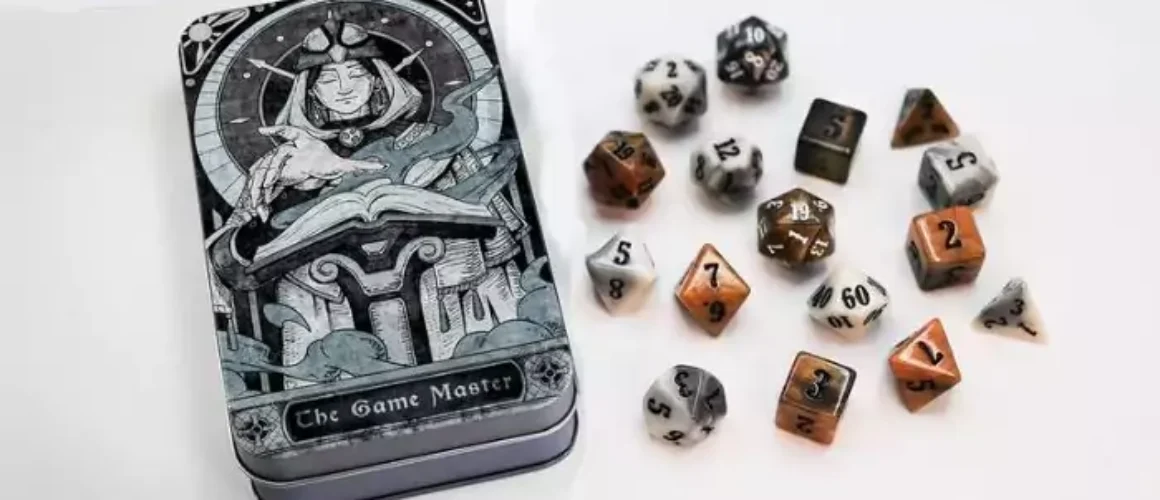
They can be, especially after you’ve chosen your class. Beadle & Grimm’s Game Master set contains 16 dice, while the class-specific tins provide different combinations for different styles of play. Their embossed tins have an EVA lining and double as rolling trays, so they offer both dice and a useful place to roll them.
Still, a beautiful set won’t make decisions for you. Start by understanding your character’s abilities, then buy accessories that solve an actual need or simply give you pleasure each time you open the tin.
What can wait until later?
Miniatures, elaborate dice organisers, custom screens, books for classes you aren’t playing and shelves full of terrain are not admission tickets. Once the group has played three sessions, the useful upgrades usually become obvious. Perhaps combat would benefit from a mat. Perhaps everyone keeps misplacing dice. Perhaps the game master needs better note storage.
A first-session checklist that won’t ruin your budget
Ask the organiser which rules edition you’re using, whether characters are provided and if any dice will be available to borrow. Bring a pencil, something to drink and a willingness to let the story go sideways. If you would like your own dice, browse dice and counters or compare the Character Class Dice range.
The moment that hooks most people on D&D is rarely an expensive accessory. It’s the instant everyone at the table realises that their hopeless plan might actually work.
Product details checked against Beadle & Grimm’s official dice range.